
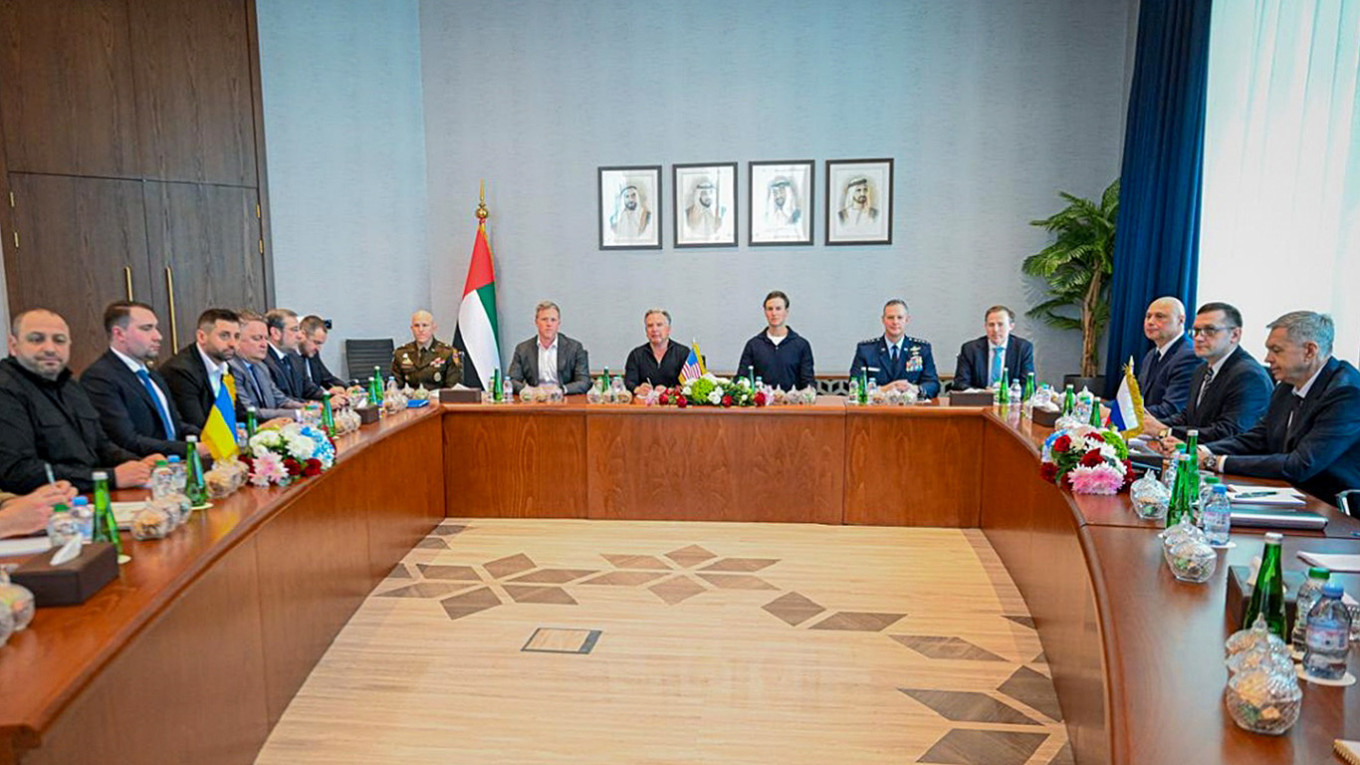
 Negotiators from Ukraine (L) the U.S. (C) and Russia (R) meeting in Abu Dhabi, February 4-5, 2026, United Arab Emirates
The second round of the trilateral meeting of the US, Ukrainian, and Russian delegations on security issues held in Abu Dhabi on February 4-5 shows incipient signs of progress, contrary to doomsday predictions. One may even say that the format is gaining traction. First of all, the protagonists were represented at the highest level of the military and intelligence. Belying the prognosis of Secretary of State Marco Rubio that special envoy Steve Witkoff and Jared Kushner wouldn’t be present, they did participate — presumably, President Donald Trump stepped in.
Witkoff later commented that the parties discussed mechanisms and methods for the ‘practical implementation’ of the peace agreement. He noted, “Over the course of two days, the delegations held extensive discussions on the remaining open issues, including methods for ensuring a ceasefire and monitoring the cessation of military activity.”
According to Witkoff, the talks were constructive and focused on technical issues; an agreement on a prisoner exchange was reached; furthermore, the US and Russia agreed to resume military-to-military dialogue, which will be led by General Alexus Grynkevich, Commander of the US European Command on the US side. Witkoff flagged that this channel of communication, which was suspended before the Ukraine conflict began in 2022, is an important element in reducing risks and maintaining stability.
Rustem Umerov, Secretary of Ukraine’s National Security and Defence Council (former defence minister) said the Russian side “was represented at a high military level” and the “work was substantive and productive, with an emphasis on concrete steps and practical solutions. We are preparing a report for President Volodymyr Zelenskyy.”
Clearly, the Abu Dhabi talks are important for Trump as it demonstrates the US’ control over the peace process and progress while marginalising the EU and Britain from the negotiations. Trump is interested in real progress at a time when he’s facing mounting domestic criticism of failure on multiple fronts. The Russian media recognises, as the independent paper Vedomosti wrote today, that “the slow pace of developments between Moscow and Kyiv does not mean they [talks] are completely ineffective.”
The paper cited an expert opinion that although public statements do not suggest a rapid rapprochement between positions and one shouldn’t expect too much from the Abu Dhabi talks in Russia-Ukraine relations, “to say that the parties are ‘marking time’ would be overly harsh… the very creation of a negotiating format should be considered a success, with new meetings already being prepared. Once negotiations have established a rut, the political cost of abandoning the negotiation process increases… While this may be a weak and minor incentive, it is nonetheless an incentive to reach an agreement.”
This is the whole point. The war lobby in Moscow and its supporters abroad ignore this. Most certainly, significant progress in bilateral cooperation between Russia and the United States has been achieved with the US European Command also announcing that Washington and Moscow have agreed in Abu Dhabi to resume high-level military dialogue.
Importantly, this includes a direct line of communication between NATO Allied Commander Europe Alexus Grinkevich and the Russian Chief of the General Staff Valery Gerasimov. The US European Command statement emphasised that “Maintaining military-to-military dialogue is an important factor in global stability and peace, which can only be achieved through strength, and provides the means to enhance transparency and de-escalation.”
Above all, the indications are that at Abu Dhabi, per Trump’s own directive, the American Russian delegations also addressed the future of strategic stability between Russia and the United States after the expiration of the New Strategic Arms Reduction Treaty (New START) on February 4. Axios, which is in the forefront of press coverage has reported citing a source that Moscow and Washington are close to “continuing compliance” with the New START.
Without doubt, this is something of a breakthrough, as it de facto picks up the thread of President Vladimir Putin’s 22nd September 2025 proposal to Trump suggesting continued adherence to the treaty’s quantitative limitations on warheads and their delivery vehicles for another year (although the treaty does not provide for the possibility of another extension.)
Axios’ Barak Ravid who is a well-informed journalist later wrote that the Russian and American teams Russia and the United States discussed “extending” the New START for a period of at least six months. Trump’s idea is that New START is no good and a new treaty is needed, which needs to be drafted.
In the absence of mutual inspection obligations, Moscow and Washington would have to trust each other’s intentions and in good faith while both sides are known to be introducing new systems, and special attention is being paid to modern delivery systems. Nonetheless, there is a sense of relief that something is better than nothing.
Of course, all this is not to claim a sea change in the Russian-American relationship. In fact, commentators close to Russian circles are reporting that Russian forces are also actively preparing for an assault on the port city of Odessa, which, if it happens, will be a defining moment — even a ‘spoiler’.
Curiously, Tass reported today citing a ‘source close to the talks in Abu Dhabi’ that any peace document must expressly stipulate that Kyiv would need guarantees that Russian troops “would not go to Odessa — that is, there should be a mechanism for something like this.”
However, in the final analysis, there is an ‘X’ factor. The Kremlin must be holding breath and watching when – not if -the Jeffrey Epstein case will finally reach the doorstep of the White House, inundating the Trump presidency. Its repercussions in U.S. politics will be observable in the short to medium term, but revealing their impact on international politics will be difficult.
Russia’s mainstay, therefore, depends largely on the facts on the ground that its armed forces can create in Ukraine. Zelenskyy and his European mentors are obviously marking their time. To be sure, the resumption of mil-to-mil dialogue at this juncture aims to give the Pentagon (and NATO) a handle to regulate in real time the trajectory of the Russian operations. Of course, how far Gen. Gerasimov will allow that to happen is another matter.