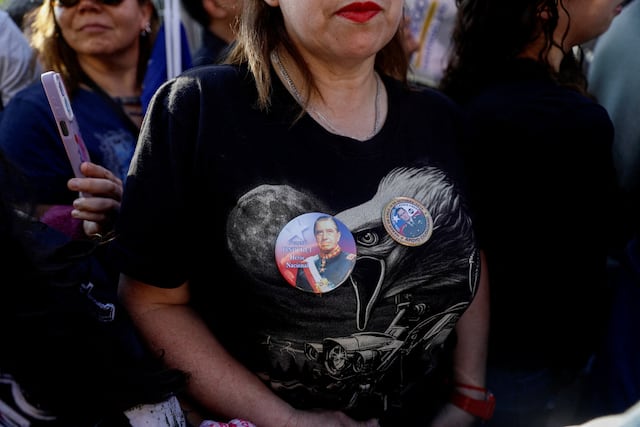
 A far-right supporter wearing an Augusto Pinochet pin at a campaign closing rally in the presidential election in Santiago, Chile
In jubilation, when news reached him from Lima that arch-conservative candidate José Antonio Kast had emerged victorious in Chile’s presidential election, Argentina’s right wing president Javier Milei posted a map of South America on X on Sunday evening with the top half coloured in red and the bottom half conservative blue. Milei boastfully captioned it, THE LEFT IS RETREATING, FREEDOM IS ADVANCING.
Kast won a landslide victory by 58 percent to 42 percent over his Communist opponent Jeannette Jara. Indeed, the line-up of US-friendly leaders is steadily lengthening in Latin America at a juncture when President Donald Trump has placed the region as a top priority in the US’ recent National Security Strategy document.
Kast’s electoral victory is not a true reflection of his popularity since Sunday’s election was a runoff in which he successfully rallied the range of Chile’s rightist forces. He had come the second best actually in the first round securing 24 percent behind Jara who was the frontrunner with 27 percent.
But that doesn’t detract from the broader message of a certain right-wing shift in the locus of politics lately in the Western Hemisphere. Election after election in Latin America seems to be producing right-wing winners, and not by small margins.
The shift calls to mind the line by the great 19th century German statesman and diplomat in the service of the Austrian Empire, Chancellor Prince Metternich who once said “Quand Paris s’enrhume, l’Europe prend froid” (‘When Paris sneezes, Europe catches cold.) Something of the Trump phenomenon could be rubbing on Latin American politics in this transition from pink to blue.
Kast’s victory follows centre-right Rodrigo Paz’s win in Bolivia; Milei’s own impressive congressional triumph in Argentina in October; and a strong performance by Nasr Asfura in Hondura’s disputed presidential election (who was supported openly by Trump.) These politicians are also joining a column of incumbent conservative presidents in Ecuador, Paraguay and El Salvador.
This has profound implications since the Hispanic population in the US is rapidly growing and for the first time in history, one out of every five people is Latino, making it the nation’s largest racial or ethnic minority.
That said, Kast’s landslide victory is not only a political earthquake but also an ethical earthquake. For, Kast is also a brazen defender and staunch follower of late Chilean dictator General Augusto Pinochet, the strongman who imposed a reign of terror on Chile from 1973 to 1990. Kast openly bragged that if the brutal dictator were alive today, “he would have voted for me.”
Yet, his campaign promises appealed to an angry, weary and confused nation eager for radical change: his vow to expel hundreds of thousands of illegal migrants; crack down on crime and narco-trafficking; to slash government spending; and boost economic growth.
It becomes difficult for an Indian to be judgmental. Expert opinion is that Kast was able to reactivate a dormant Pinochetism in Chile. To be fair to Kast, he wore on his sleeve his admiration of the repulsive dictator even after Pinochet left power in 1990. The tantalising question is how come a defender of the brutal regime under which an estimated 40,000 people were tortured and more than 3,000 killed be chosen by the Chilean people as their next leader.
But a truth dig shows that even when he lost a plebiscite in 1988, Pinochet still commanded 44% of the vote. After the dictator’s exit, his constituency or support base simply transferred to other conservative parties especially the Unión Demócrata Independiente (UDI), which ruled the country. Kast himself broke away from the UDI as he found it was moderating the party’s authoritarian roots.
It was a shrewd move. According to a recent opinion poll, roughly a third of Chileans regard Pinochet to be one of the “best political leaders in the country’s history” and believe that if only politicians followed his ideas, the country would “regain its place in the world”.
That said, in great measure, Kast also owes his victory to the failure of President Gabriel Boric’s left-wing government on issues like inflation and crime, and its poor economic performance. In real terms, Chile’s economy has barely grown since 2018. Meanwhile, nationwide insecurity and undocumented immigration also became major concerns, which Kast exploited during the campaign to augment his very conservative, traditional stance on social issues, and his pro-Pinochet views.
Arguably, Kast is representative of something that has been happening not only across Latin America but also other parts of the world, including India — the displacement of the centre-right by a much more affirmative right.
Now, what form the new right takes depends very much on the country. In Argentina it is libertarian; in El Salvador it is highly authoritarian; in Bolivia, where Rodrigo Paz won the election recently, it is reformist rather than ideological.
Beyond Latin America, the Trump presidency in the US represents a new right variant that is nationalist and nativist; in France and Germany it is anti-globalist; in Poland it is ‘pro-China’; in Hungary it is ‘pro-Russia’ — and in India, it rides the wings of ethnocentric nationalism.
Kast’s economic agenda is similar to Milei’s in Argentina — promise to shrink the government; open lithium to private investment; privatise Codelco, the state-owned copper giant, etc. He shares Trump’s calls for the expulsion of immigrants and the construction of nativist walls, but unlike the US president, he is a free-marketeer. But then, his leadership will have to be very effective as he does not command a majority in the parliament to legislate — and party discipline is notorious in Chile.
Where he stands a greater chance of success is on the economy, about which he has clear ideas. Chile was once the symbol of economic success due to its open market policies. Chile and the United States have had a very special trade relationship for a long time. But Chile’s largest trading partner today is China and the US will have an uphill challenge to supersede that. On the other hand, Chile’s largest investment partner is the US but that is the case with many countries in Latin America.
In the final analysis, Kast reflects the pervasive anti-incumbent mood that has gripped South America and boosted the radical right at a time when Trump is seeking to influence the region’s political future. Speaking to reporters in Washington, Trump praised Kast on Monday as “a very good person,” adding, “I look forward to pay(ing) my respects to him.” Secretary of State Marco Rubio later said he held a phone call with Kast to discuss “expanding economic ties and ending illegal immigration.”
For sure, far-right does not alienate Beijing anywhere on the planet; Chile becomes a turf of serious contestation between the US and China for influence in Latin America going forward. China’s increasing sway in the region raises concerns in Washington, prompting greater US engagement. But China, unlike other major powers, practises what it preaches and will remain fundamentally a civilisation state that is neither expansionist nor hankering after spheres of influence — rather, content with a level playing field, as the South Asian experience testifies.
Monroe Doctrine as such, rooted in the concept of “America’s backyard” where Washington historically asserted dominance through military, economic, and political intervention to protect its interests, has become archaic — and is no longer enforceable. Trump has had a taste of such experience already over Greenland, of which he seldom talks lately.
Succinctly put, most of the reasons for the right’s ascendance stem not from factors abroad but from changing realities within Latin America. Far right is not a majority anywhere in Latin America, it’s usually 25-30% of electorates, but it has got political momentum, and that clearly helped Kast in Chile.