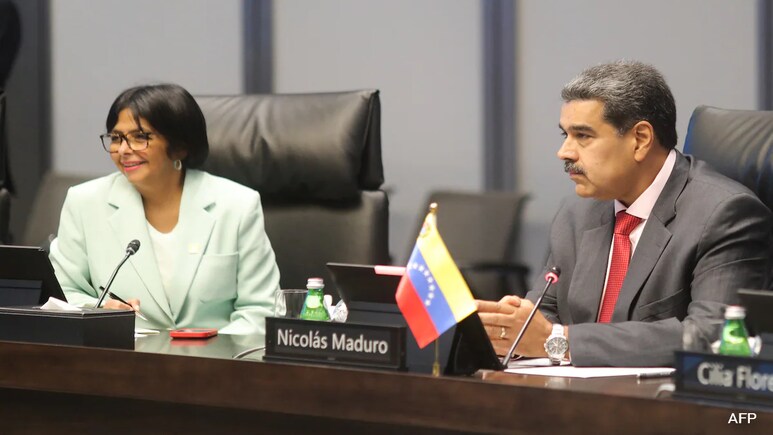
 Venezuelan conundrum: Acting president Delcy Rodriguez (L) wins US’ confidence to replace president Nicolás Maduro(R), is the daughter of left-wing guerrilla fighter Jorge Antonio Rodriguez
In a pointed reference to the Chinese leadership by name, the Russian state news agency Tass took note of Beijing’s criticism of the US aggression against Venezuela. Unsurprisingly, Tass quoted a third party, Karin Kneissl, former Austrian foreign minister and the current head of the G.O.R.K.I. centre at St. Petersburg State University — a well-known echo chamber of the Kremlin establishment — to flag that China’s president Xi Jinping kept mum on the topic.
Kneissl herself showed understanding for Xi’s reticence lest he’d have been expressing a personal reaction, considering that “Still it is a personalised policy that Trump pursues. It means that if someone wants to respond to it, they will actually have to do the same. At the end of the day, we see statements from the Chinese Foreign Ministry and press releases from various other places, but what has really happened?”
Kneissl pointed out that Brazilian President Lula beat his ineffectual wings in the void in vain because he was acting “alone.” Kneissl also took a swipe at the BRICS grouping to underscore it’s a toothless grouping. In her words, “We talk about BRICS a lot, but BRICS is a forum, not an organisation. BRICS has no mechanisms. Dozens of seminars and conferences are held, but it is still just a platform for dialogue… there is no BRICS secretary general who could say: ‘We will now take some action.’ There is simply no way of doing so.”
That was an unkind cut since Russia and China had plentiful opportunity to mould BRICS as an anti-imperialist platform but let it pass with great deliberation.
Coincidence or not, the Tass interview with Kneissl appeared within the week of a ‘good conversation’ between External Affairs Minister S Jaishankar on Tuesday with his American counterpart Marco Rubio during which they discussed “trade, critical minerals, nuclear cooperation, defence and energy.”
Apparently, the US aggression against Venezuela didn’t even figure as a significant enough talking point, although this was Jaishankar’s first interaction with Rubio, the real architect of the Trump administration’s startlingly innovative regime change strategy towards Caracas anchored on an improbable co-habitation between the entrenched leftist government figures in power who control the state apparatus and the viscerally anti-communist pro-American opposition forces in the country.
The US’ regime change script for Venezuela ensures that the more things change in that country, the more they stay the same (Plus ça change, plus c’est la même choseq — an aphorism by French critic Jean-Baptiste Alphonse Karr.) Anyway, Jaishankar and Rubio kept a discreet distance from Venezuela, this was their first interaction after India assumed the captaincy of the 2026 BRICS Summit meeting. By the way, Trump promptly threatened to impose 25% additional tariffs on any country that traded with Iran.
In the Tass interview, Kneissl, a longstanding personal friend of Putin, indirectly pokes India to take an upfront stance during its BRICS chairmanship. Of course, it costs Moscow nothing to proffer such gratuitous advice to the Indian policymakers.
Seriously, though, would Jaishankar pay heed to Kneissl’s audacious call for the institutionalisation of BRICS as a formal organisation with a secretary-general, et al., during India’s chairmanship? Highly improbable.
Delhi will remain cautious that Trump is sworn to bury BRICS. It studiously kept out of the first-ever BRICS Plus weeklong naval exercise (led by China and involving South Africa, Russia and Iran) earlier this month.
The heart of the matter is that the BRICS countries are pursuing their own interests independently in the emergent Latin American situation. They do not see the paradigm as the template of an anti-imperialist struggle, in ideological or systemic terms. Take Russia, for instance, which is more of an opportunistic geopolitical player in Western Hemisphere than a significant economic force, which focuses on arms sales, partnerships with a clutch of anti-Western governments (Cuba, Nicaragua), and overall husbands whatever scarce soft power is there at its disposal to debunk US influence and challenge Western narratives.
China, on the contrary, is a serious player in the Western Hemisphere. A profound need arises for Beijing to go back to the drawing board and work out a high-stakes recalculation of its geopolitical / geo-economic ambitions — that is, assuming that Trump’s ‘Donroe Doctrine’ indeed gains traction. Venezuela is the only country in Latin America with which Beijing had an ‘all-weather partnership,’ the highest diplomatic honour it would bestow on a friendly relationship.
China is unlikely to make new advances in Latin America in the near term, while it weighs in on the variables at work. Even a potential trade-off with Trump (who is travelling to China in April) is entirely conceivable. Logically, if the Western Hemisphere belongs to the US, then the Taiwan Strait belongs to the Chinese (which would, arguably, create favourable circumstances for the peaceful unification with Taiwan, Beijing’s preferred option always.)
What needs to be factored in is also that China’s influence in Latin America has been on the wane through the past year after Trump’s return to the White House. (Mexico recently imposed 50% tariffs on Chinese EVs; Panama has pulled out from the BRI; Honduras is moving toward restoring ties with Taiwan.) Indeed, the ruling circles in Caracas too are signalling a thaw with Washington; the acting president Delcy Rodriguez said on Tuesday while announcing the release of 400 political prisoners, per Trump’s demand, “The message is very clear. Venezuela is entering a new political moment that allows for understanding despite differences.”
Trump has disclosed that a visit by Rodriguez, an erstwhile firebrand with impeccable revolutionary pedigree, to Washington is in the cards, followed by his own return visit to Caracas soon after. Today, in her first state of the union address since former president Nicolás Maduro was seized by the US, Rodríguez proposed new reforms that remove obstacles to US involvement in the country’s oil industry — a move away from Maduro’s policies. Rodríguez said she was not afraid to face the US “diplomatically through political dialogue,” adding Venezuela had to defend its “dignity and honour.”
The bottom line is that China’s new calculus in the Western Hemisphere may appear only at the April summit between Xi and Trump. What cannot be ignored is that Beijing must take seriously Trump’s willingness to use hard power, which proves that American resolve is a reality going forward. Significantly, the 2025 National Security Strategy frames Taiwan as an indispensable gear in the world economy.
Kneissl’s acerbic remarks are a further confirmation that a coordinated Russian-Chinese move on the Western Hemisphere will be a far-fetched scenario. Both countries take a ‘de-ideologised’ view of the paradigm shift in the US’s strategy and will doggedly pursue self-interests.
In fact, the Kremlin has already begun moving the pawns on the chessboard by preparing to receive Trump’s special envoy Steve Witkoff and son-in-law Jared Kushner in the coming days.
While Trump may have upended China whose regional ambitions in Latin America have been thrown into disarray, Russia on the other hand, is pinning hopes to make hay in Ukraine’s killing fields as the sun shines on Trump’s rambunctious bandwagon of revolutionaries and reactionaries that is rolling into Caracas.