
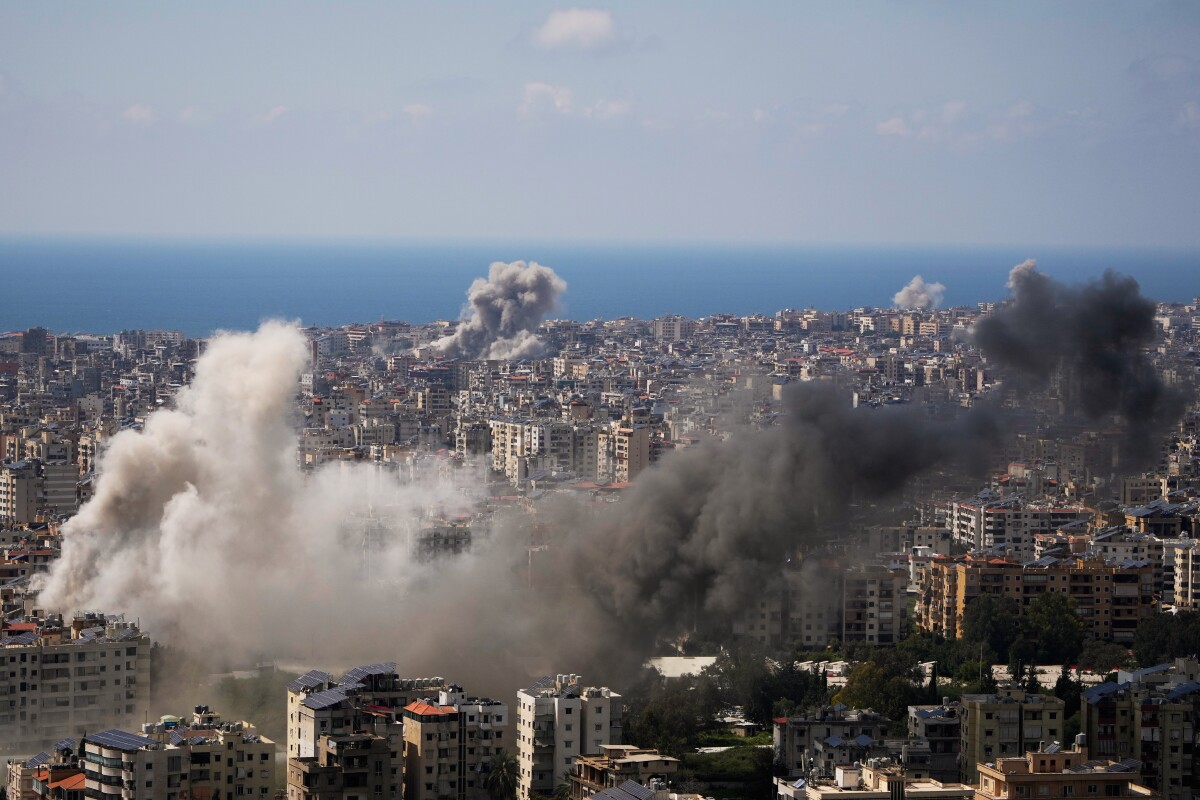
 Smoke rises following Israeli airstrikes, Beirut, April 8, 2026
A Tass report with Islamabad dateline confirmed a few hours ago that the US-Iran talks will be held on Saturday at the Serena Hotel in the city “and are expected to last several days.” The incredible blunder of Prime Minister Narendra Modi’s visit to Israel just two days before the vicious US and Israeli attack on Iran played into the hands of Pakistan’s diplomacy, which has been on the rise since then in West Asian politics.
It is culminating this weekend in the country’s appearance at the centre stage of international diplomacy as the principal broker of the US-Iran truce that is poised to lead to the first high-level political talks between the United States and Iran since the 1979 Islamic Revolution.
This is another landmark event in Pakistan’s international diplomacy after facilitating the Sino-American détente 55 years ago. Ignoring the scornful remarks on Pakistan’s role by high officials and spokesmen of the ruling elite in Delhi belittling the leaders in Islamabad as ‘Dalal’, ‘Postman’, ‘Courier’, etc, Pakistan shrewdly walked through the door opened by Modi innocently by his untimely visit to Israel, to stride into the vortex of the war in the Persian Gulf in an improbable role of ‘Vishwaguru’ (world leader).
Be that as it may, the US-Iran truce looks fragile and ridden with contradictions. But then, arguably, it is better to have tried and failed than never to have tried at all. The famous quote about quitting by the Irish poet and playwright Samuel Beckett comes to mind, ‘Ever tried, Ever failed. No matter. Try again. Fail again. Fail better.’
The contradictions in the current scenario are not easy to reconcile without a resolute political will in the White House to end the war. It is a bitter pill to swallow for Trump to settle on Iran’s terms, but the logic of war plus the gathering storms in US politics as the midterms loom large leave him with no real alternative but to negotiate.
It may seem the US sanctions are the main hurdle to a deal. Not really. Of course, it is the irreducible minimum for Tehran. But once at least, on July 27 last year, in the context of the first American attack on Iran’s nuclear sites, Trump himself had written, “During the last few days, I was working on the possible removal of sanctions, and other things, which would have given a much better chance to Iran at a full, fast, and complete recovery.” (See the US Congressional Research Service report U.S. Sanctions on Iran dated August 19, 2025.)
Again, immediately after the present truce declaration on Monday, Trump announced that Washington is in talks with Iranians regarding the reduction of tariffs and sanctions. Writing on his social media platform Truth Social, Trump hinted at what was already agreed upon at the Geneva talks: “The United States, in cooperation with Iran, will unearth and remove all nuclear ‘dust’ buried deep underground.” (See the transcript of Omani foreign minister’s interview with CBS News, February 27, 2026)
According to Trump, this nuclear material is “now under strict satellite surveillance, and nothing has been touched since the date of the attack.”
Indeed, paradoxically, the Iran nuclear issue was virtually resolved through negotiations already when Trump launched the war.
Admittedly, Trump since posted another announcement that the US will impose a 50% import tariff on goods from any country that provides military weaponry to Iran; there would be no exceptions or waivers in this regard. But that is a template of another war that Trump has been waging — weaponisation of tariffs in trade. Russia and China, who likely provide military assistance to Iran, will not be deterred. What Iranian military really needs is technology to preserve the deterrent capability of its missiles and enhancement of air defence capabilities and vital intelligence inputs.
To my mind, the most intractable issue in Tehran’s 10-point plan to end the war is its demand that there should be an end to the war on all fronts, including Israeli military operations against Hezbollah in Lebanon. Israel, on the other hand, while pro forma welcoming Trump’s truce offer, has added the caveat that its military operations in Lebanon will continue.
This is a potential ‘deal breaker’. Israel has intensified its attacks in Lebanon on Wednesday hitting several commercial and residential areas in Beirut without warning in which at least 182 people have been killed and hundreds were wounded. It was one of the deadliest days of Israeli aggression.
Predictably, Iran’s reaction has been decisive. The IRGC’s aerospace commander Gen. Seyed Majid Mousavi stated, “Aggression towards Lebanon is aggression towards Iran.” He declared that IRGC is preparing a “heavy response”. Meanwhile, Tehran reportedly closed the Strait of Hormuz and also attacked Saudi Arabia’s East-West pipeline connecting the Red Sea port of Yanbu and related oil facilities of American oil companies.
The closure of the Strait of Hormuz puts renewed pressure on Trump. (See my blog There is no military solution to Strait of Hormuz, Indian Punchline, March 3, 2026) The big question is whether he is willing or capable capable to rein in Israel, which is of course the ultimate litmus test of the durability of Trump’s truce offer.
In reality, Israel is viscerally opposed to an end to the war until Iran is reduced to a ‘failed state’. This is because, first and foremost, Israel is worried about the ‘unfinished business’ of Iran’s missile capability; second, Tehran’s toll system in the Strait of Hormuz is also a money spinner capable of generating an income out of toll fee of around $64 billion, which, along with $100 billion by selling oil and gas in $CNY (settled in Chinese yuan instead of US dollars) may potentially boost Iran’s GDP by around one-fifth — apart from reshaping the global energy markets.
Three, in geopolitical terms, Israeli swagger that it vanquished the resistance groups in the past 2-3 years of war now turns out to be baloney, as Hezbollah is back to staging increasingly more audacious rocket attacks on Israel.
Fourthly, Netanyahu will face some tough questions during the upcoming parliamentary election in Israel as to what has been achieved in the war on Iran as well as his culpability in the October 7 attacks in 2023 by Hamas; and, finally, if peace dawns, Israel will inevitably face a tsunami of international opinion demanding a resolution of the Palestine problem, the root cause of the Middle East crisis, which is antithetical to the Zionist project of Greater Israel.