
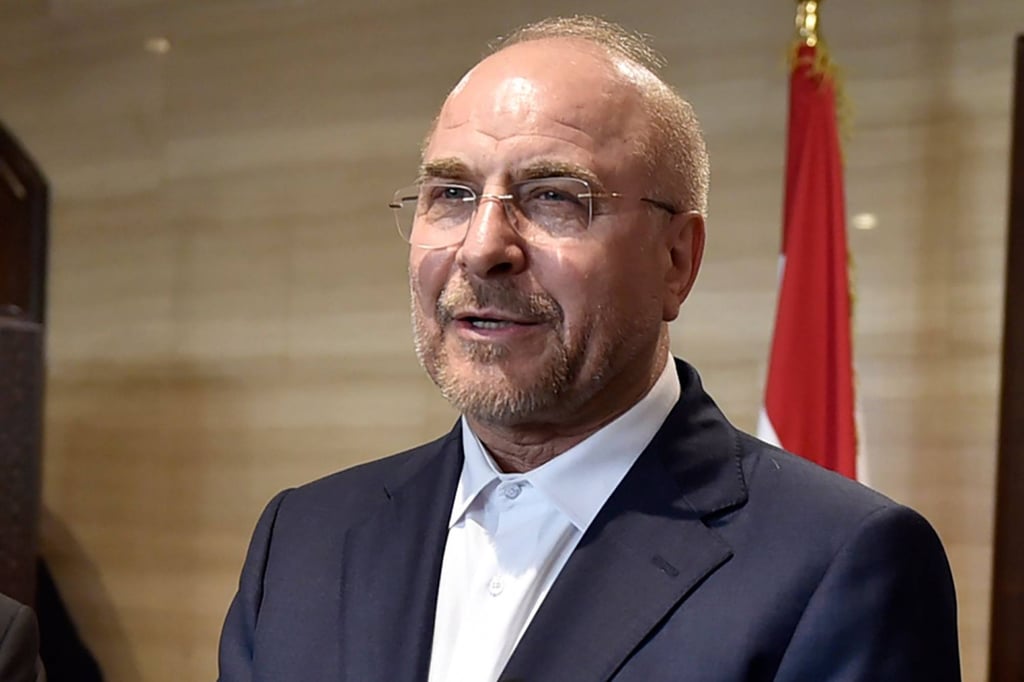
 Mohammad-Bagher Ghalibaf, Iran’s parliament speaker, has emerged as the highest-profile political figure in Tehran
The profound significance of the two successive Iranian missile strikes on Dimona nuclear research centre, the most heavily guarded site in the whole of Israel, is sinking in, and it inevitably shifts the trajectory of the US’ war in Iran. Hardly four days after the first Iranian strike on Dimona in the evening of March 21, the US President Donald Trump is seeking to end the three-week old conflict via an ingenious pathway of a partial “deal” that would allow the US to claim its goals have been achieved.
If there is anyone in the Trump administration who can secure for the president such a deal, it is only Vice-President JD Vance, who is known to be a sceptic of the war and is a stakeholder himself who fervently hopes that the war does not become an albatross for the presidency. Trump’s choice of Vance for the upcoming phase of negotiations is, therefore, to be noted carefully.
The Americans had initially insisted before the conflict began on an expanded agreement with goals extending beyond Iran’s nuclear programme — limiting Iran’s missile arsenal; ending its support for the resistance groups; and, possibly, even achieving ‘regime change’ in Tehran. But they have come to realise that all that they can show today as ‘achievement’ they may have compelled Iran to draw into its missile potential. But as the attack on Dimona messages, Iran has still surprises in store.
The upcoming negotiations will run on a negotiating track unlike the previous rounds in Muscat and Geneva, since Iran is having the upper hand. Tehran has added a range of new demands — removal of US bases in the Middle East; release of its ‘frozen’ financial assets in western banks; lifting of sanctions; a security guarantee. To be sure, Iran will seek more favourable terms than it sought in the previous rounds.
Prima facie, this lends credence to a perception that the ‘hardline’ factions of the regime are dominating. But that isn’t necessarily the case. Take, for instance, the Majlis speaker Mohammad Ghalibaf, a flamboyant political personality with whom Washington is reportedly preparing to negotiate. He has the reputation of a ‘hardliner’ but also has a track record of taking a more central role, as his long stint for well over a decade as the populist mayor of Tehran testifies. His public remarks may emphasise resistance, national strength, and the need to confront external pressure rather than compromise, but Trump’s decision to engage with him is based on the understanding that Washington can do business with him.
In what seemed to be a reference to Ghalibaf, Trump told CNN’s Kaitlan Collins on Monday that the US was having “very strong talks” and was “dealing with the man who is most respected” in Iran… We’re dealing with some people that I find to be very reasonable, very solid. The people within know who they are, they’re very respected, and maybe one of them will be exactly what we’re looking for.”
Wall Street Journal has since reported that the US and Israel have temporarily removed Ghalibaf from their target list for decapitation.
Suffice to say, much will depend on Vance’s sagacity to draw out the realist in Ghalibaf and encourage him to negotiate in a spirit of pragmatism. Much will depend on how the US accommodates Iran’s core interests, which are first and foremost, economic concessions, non-aggression guarantees and a review of the American military presence in the region.
A ‘deal’ is doable. The New York Times reported, citing unnamed officials in Tehran that Iran has told the US that it is not interested in a temporary ceasefire, but seeks a full peace agreement with guarantees against future attacks by the US and Israel. Arguably, Trump’s recent statements, effectively attempting to present the current situation as a political outcome already achieved, fit into this logic.
Interestingly, Trump declared that “regime change” has already occurred in Iran, pointing to the emergence of new leaders with whom Washington is prepared to engage in dialogue. He simultaneously announced a “significant gift” from Tehran related to the oil and gas sector — hinting at economic concessions. The Iranian side did indeed propose vistas of economic cooperation—from joint investments in energy to the purchase of American aircraft and the participation of US businesses in the strategic sectors of Iran’s economy.
On Monday, Trump discussed with prime minister Netanyahu a deal that will be consistent with the military operation’s basic objectives. The point is, the salience in the willingness of the parties to de-escalate tensions, even without a full-fledged agreement. To this end, Trump is also attempting to establish working channels of communication with the Iranian leadership.
While Tehran’s official position continues to be that no direct negotiations with Washington are underway, contacts are going on between Vance and an unnamed Iranian parliamentarian — per Al-Monitor, which is wired into the Israeli establishment. Indeed, Tehran’s softening rhetoric lately also suggests that certain negotiating tracks may have opened through the mediation of third countries such as Egypt, Turkey, Qatar, and Pakistan.
The big question is whether all these incipient signs are indicative of the Tehran elite’s willingness for de-escalation. The signs are hopeful. Axios reported that a meeting involving high-ranking US and Iranian officials in Islamabad is under discussion.
The energy market is a dependable weathercock in such times. According to the Financial Times, shortly before Donald Trump’s announcement of “productive talks” with Iran, large oil futures trades were made on the New York Stock Exchange— contracts worth approximately $850 million were concluded in just minutes. And, following Trump’s tweet announcing the postponement of strikes on Iranian energy infrastructure, oil prices plummeted, while stock indices surged! This strange coincidence naturally raised suspicions of ‘insider trading.’ White House, however, insists that the administration’s actions are driven solely by national interests.
Meanwhile, Saudi Arabia and the UAE are actively pushing Trump to take the war to its bitter finish and ‘erase’ Iran’s presence in the geopolitics of the region. Simply put, the two most powerful Sunni Arab oligarchies are on the same page as Israel. Such interference increases the risk of a breakdown in dialogue between the US and Iran.