
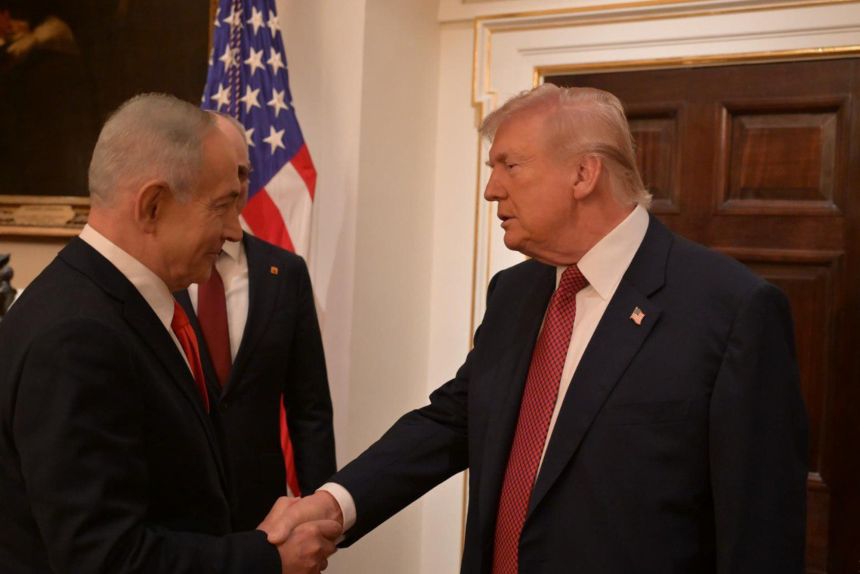
 The US President Donald Trump (R) met with Israeli Prime Minister Benjamin Netanyahu at the White House, February 11, 2026
Picking up the threads from where I last wrote on the US-Iran negotiations a week ago in my blog titled Odds are 8-1 Trump won’t start a Gulf war, the talks beginning in Geneva today are going to be crucial. A US delegation, including envoys Steve Witkoff and Jared Kushner, will meet with the Iranians on Tuesday morning.
The stunning backdrop is the dramatic disclosure by US President Donald Trump yesterday that “I’ll be involved in those talks, indirectly. And they’ll be very important.” Trump added that Iranians were motivated this time around to negotiate.
Evidently, the backchannel is hyperactive. The salience here must be noted carefully: Trump who has, of late, been both threatening and cajoling Tehran, is now openly identifying himself with diplomacy. This is something that has never happened before.
Israel must be worried like nobody’s business. Its worst nightmare scenario is here — a US-Iranian deal.
There have been some positive remarks from the Iranian side as well. Iran’s Deputy Foreign Minister Majid Takht-Ravanchi told the BBC in an interview published on Sunday that Iran is ready to consider compromises to reach a nuclear deal if Washington is willing to discuss lifting sanctions. Iran’s atomic chief said last week on Monday that Tehran could agree to dilute its most highly enriched uranium in exchange for all financial sanctions being lifted.
On the other hand, following a hastily arranged two and a half hour conversation with the visiting Israeli Prime Minister Benjamin Netanyahu last Wednesday in the White House, Trump publicly stated that he insisted that talks with Iran must be given a chance and he mentioned a one-month timeline.
Meanwhile, the Trump administration has also edged away from any overt support for regime change in Iran. Vice-President JD Vance put it this way: “Well, look, I mean, if the Iranian people want to overthrow the regime, that’s up to the Iranian people. What we’re focused on right now is the fact that Iran can’t have a nuclear weapon.”
Such a minimalist agenda is precisely what Iran is seeking. Tehran’s refusal to agree to a zero uranium enrichment was a key sticking point so far but Iran’s atomic chief stated last Monday, a way could be found by Tehran agreeing to dilute its most highly enriched uranium stockpile, as an example of flexibility to meet Washington’s concerns that uranium enrichment in Iran might be a potential pathway to nuclear weapons.
However, Netanyahu is hanging tough. After return from DC, he repeated that a deal must include enriched material leaving Iran. “There shall be no enrichment capability – not stopping the enrichment process, but dismantling the equipment and the infrastructure that allows you to enrich in the first place,” he said.
As a mark of displeasure, Netanyahu claimed that he aimed to end US military aid to Israel after the current 10-year deal of receiving $3.8 billion a year ends in 2028. Reuters reported, quoting Netanyahu, “we can afford to phase out the financial component of the military aid that we’re receiving, and I propose a 10-year drawdown to zero. Now, in the three years that remain in the present memorandum of understanding and another seven years draw it down to zero. We want to move with the United States from aid to partnership.”
According to the rumour mill, the back-and-forth at the meeting in the White House last Wednesday was rather animated, as Netanyahu got agitated, but Trump wouldn’t budge. This is despite the commentariat predicting that Trump, like many world leaders today, is vulnerable to Mossad’s blackmail over the Epstein affair (it has been alleged that Epstein worked for Mossad; his longtime lover Ghislaine Maxwell is the daughter of a former Mossad station chief in the Washington embassy.)
But to be fair, Trump did whatever he could to help Netanyahu live a decent retired life at home with his family by making a personal request to Israeli president Issac Herzog in June to exercise his prerogative as head of state to grant clemency to Bibi from prosecution on corruption charges after leaving office. Trump condemned the cases, not because of evidence pointing to Netanyahu’s innocence, but because the American president believes the Israeli prime minister is an ally and “a WARRIOR.” Last Thursday, Trump lost his cool and called Herzog ‘disgraceful’. He told reporters, “The people of Israel should really shame him” for not letting Netanyahu off the hook.
Now that Trump has gone more than half the way and staked his prestige, if the Iran talks end in failure, there could be unpredictable consequences. Trump is a peace-loving man and his demands have narrowed down to Tehran committing itself irrevocably to give up a nuclear weapon programme. It is not too much to ask.
Tehran, in any case, is not seeking an atomic bomb. And Tehran has a credible deterrence in its missile programme. What it desperately wants is a lifting of sanctions so that its economy can integrate into the world market and its vast natural and mineral resources can be tapped. It is not too much to ask, either.
However, it is not so easy as it seems. In a highly provocative move, Israeli security cabinet approved a proposal yesterday to register large areas in the West Bank as “state property” for the first time, which makes it easier for Jewish settlers to buy land in the West Bank. Trump has repeatedly spoken against any such move, insisting that the annexation “is not going to happen.”
Israel is determined to play the role of spoiler. How far Trump can push the envelope is a moot question as Netanyahu might go to any extent, as Barack Obama experienced when the JCPOA was nearing the home stretch in 2015. Reportedly, Trump did not allow Netanyahu to address the Congress last week.