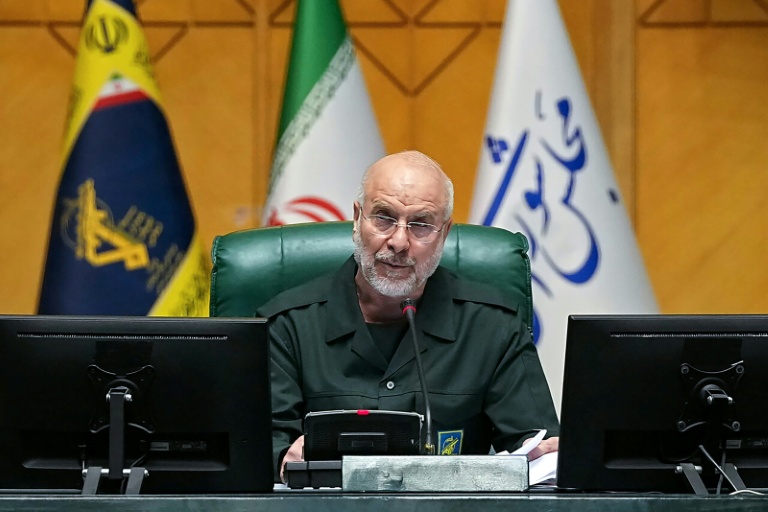
 Majlis speaker Mohammad-Bagher Ghalibaf will be heading the Iranian delegation at talks in Islamabad with US officials (File photo)
The glaring differences between the United States and Iran notwithstanding, the talks beginning in Islamabad tomorrow have a fairly good chance of being a success. There is too much at stake, and there are unifying factors where commonality of business and economic interests of the two leaderships outweigh geopolitical considerations.
President Donald Trump has a counterpart in Majlis speaker Mohammad-Bagher Ghalibaf heading the Iranian delegation, who is also self-made billionaire-politician like Trump and believes that all good politics is principally about creating wealth — for oneself as well as for the country.
The routes they took in their meteoric ascendancy in politics were different but Ghalibaf is also not a cleric or a doctrinaire ideologue who he rose through hawza (religious) seminaries or theological networks. Ghalibaf’s strategic asset lies in his revolutionary credentials — sacrifice, command experience, and institutional loyalty — by virtue of his long experience in the war with Iraq while serving in the Revolutionary Guards, then in the broader state machinery.
Alex Vatanka, author of books on Iran and a Senior Fellow at the Washington-based think tank Middle East Institute (funded by the petrodollar Gulf states), recently wrote, “For all his (Ghalibaf’s) hardline rhetoric, for all his long record in the security state, he is one of the few senior figures left in Tehran who can plausibly be described as both a regime insider and a functioning political operator. He belongs to the Islamic Republic’s military elite, but he has also spent years trying to translate that pedigree into broader governing authority. That combination is what makes him matter.”
The defining moment in Ghalibaf’s career trajectory came in 1989 when he landed the job of the chief executive of the Mostazafan Foundation, a charitable organisation, which he brilliantly turned into the second-largest commercial enterprise and a vast empire. Such foundations — or Bonyads as they are called — by virtue of their nexus with the IRGC wield enormous political power, control the commanding heights of the country’s economy and is the glue of Iran’s political economy.
Ghalibaf’s business empire spanning infrastructure, construction, real estate, etc. enabled him to build a network of loyal allies and partners, and to shape policy and advocate for his interests. In turn, Ghalibaf’s unparalleled wealth and influence made him a formidable force in Iranian politics.
Suffice to say, Ghalibaf makes an ideal partner for Trump to steer the battered ship of US-Iran relationship out of troubled waters. Trump’s circle is sure to appreciate Ghalibaf’s shrewd business acumen. Tehran has already proposed to the Trump administration the seamless business opportunities including in the oil and gas sector, if only the ties between the two countries are normalised.
It is from such a perspective that the 10-point plan put forth by Iran this week are to be viewed. Arguably, there are no major obstacles to reaching an agreement, now that the nuclear issue has already been negotiated threadbare and a common ground is available.
If we were to flesh out the 10-point plan ad seriatim, the main sticking point is the last item on ‘An end to the war on all fronts, including military operations against Hezbollah in Lebanon.’ And that is because Israel’s specific interests come in. But the good part is that there is universal condemnation of Israel’s attempt to annex Lebanese territory with the very same brutal methods it adopted in regard of Gaza.
The first 7 items basically non-issues, they leap out of the 2015 nuclear deal (JCPOA). Item 8 about ‘Compensation for damage inflicted on Iran’ and item 9 regarding ‘The withdrawal of US troops from the region’ have wrinkles to be ironed out but some modus vivendii is possible.
Significantly, Tehran refrained from pressing its demand at item 8 as ‘war reparations’ and instead seeks ‘compensation.’ This is where the US’ willingness to accept Iran’s control of the Strait of Hormuz comes in. ‘Compensation’ can be in the nature of generating an income out of a toll system in the Strait of Hormuz whereas war reparations is an admission of guilt.
Trump has still not forgiven Barack Obama for releasing Iran’s blocked funds in circumstances related to the final stages of the JCPOA negotiations, amounting to around $1.7 billion of Iranian funds that were frozen by Jimmy Carter administration (which included $400 million by way of interest) in a 1979 assets freeze following Iran’s seizure of the US Embassy in Tehran and the detention of American diplomats.
Trump seems to be open to Iran generating income via a toll system in the Strait of Hormuz and speculated playfully that the US could jointly operate the new system with Tehran and earn some money on the side.
The heart of the matter is that Trump seems to have estimated that Ghalibaf is a pragmatic politician who is receptive to close relations with the US and is enthusiastic about fostering business and economic ties in particular. Don’t be surprised that if things go well, the two of them might even strike a friendship.
Politico reported recently that the Trump Administration was “quietly weighing” Ghalibaf as “a potential partner—and even a future leader.” An Administration official told the paper that Ghalibaf was a “hot option” but the choice was not final as the US still would have to “test” him and weigh other prospects: “We can’t rush into it.”
“We are dealing with a man who I believe is the most respected,” Trump said, adding that it was “not the Supreme Leader” and that his Administration has not heard from Mojtaba Khamenei at all.
Ghalibaf has long been seen as a protégé of late Supreme Leader Ayatollah Ali Khamenei and a confidant of his son Mojtaba, the new Leader — and a close friend of Gen. Qasem Soleimani, one of Iran’s most powerful and charismatic figures, whom the first Trump Administration assassinated in 2020.
Unsurprisingly, Ghalibaf’s ascension raised concerns about the entrenchment of crony capitalism and the dangers of conflating business interests with politics in Iran’s political economy, and will be a constant reminder that the lines between business and politics are increasingly blurred in the Islamic Republic.
Trump should find it a comforting thought that Ghalibaf could be an Iranian equivalent of Mikhail Gorbachev with whom Margaret Thatcher noted after their very first encounter in 10 Downing Street in 1984, even before he became the Kremlin boss, that “We can do business together.”