
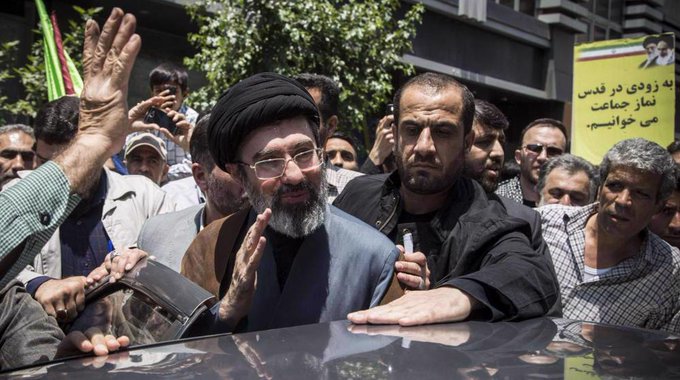
 Iran’s new Leader Ayatollah Seyyed Mojtaba Khamenei (File photo)
The stunning message from the first public message on Thursday by Iran’s new Leader, Ayatollah Seyyed Mojtaba Khamenei is that “The Strait of Hormuz must remain closed.” In seven words, he threw the gauntlet at President Trump belying all expectations that he will opt for continuity in policy. Not only is Trump in no position to decide a timeline for the war but Mojtaba effectively announced the next phase — a war of attrition. “The will of the people is to continue effective defence”, he stated.
In sharp contrast with Trump’s style of dictating Americans’ information diet, a significant part of Mojtaba’s statement was devoted to the central role of the Iranian people. For Iran, this war is not an “excursion”; nor is the “win” measured with coffee spoons as in sports, where the score declares the victor in a timeline.
CNN’S Nick Walsh began his brilliant essay today with these words: “The bravado and gamer-style videos of the US government… belie the extraordinary seriousness of an intractable moment: how far do the Americans have to go, not just to declare ‘we won’, as Trump did Wednesday,… but to make Iran behave as if it has suffered a defeat?
“Trump is now caught in the oldest trap of modern warfare — believing a swift, surgical military operation will yield quick, enduring political faults… Whatever force a military fails or succeeds in applying at the start, the people it is attacking have greater commitment to defending their lands and hones.”
Indeed, the world is taking note — including India’s prime minister. After hanging out with Prime Minister Benjamin Netanyahu in Tel Aviv three days before the attack on Iran and pledging, during a vainglorious speech at the Knesset, to be with him shoulder to shoulder in his forever wars with political Islam, Modi had a rude awakening and dialled up President Masoud Pezeshkian yesterday urging peace, even as Iranian missiles tore into the heart of the state of Israel and Netanyahu went into hiding.
From Mojtaba’s statement, his strong ties with the Axis of Resistance, the IRGC and his particularly close relationship with Hezbollah, his ascendance signals a pivotal moment, marking the confrontation entering a phase of attrition, shifting from temporary military escalation to a sustained pattern of operations, deterrence and endurance.
Mojtaba’s pointed reference to the closure of the Strait of Hormuz is the salience of the new phase to hurt the US economy where it hurts most. But he added, “One point I must emphasise is that, in any case, we will obtain compensation from the enemy. If it refuses, we will take from its assets to the extent we deem appropriate, and if that is not possible, we will destroy its assets to the same extent.”
The concept of justice and resistance that gave underpinning to the 1979 Iranian Islamic Revolution is roaring back to the centre stage. Mojtaba’s vision combines traditional Shia narratives, anti-imperialist narratives, and grassroots mobilisation. The three central tenets of the resistance are the struggle against “imperialist arrogance”, cultural resistance, and autonomy.
Lest we forget, Mojtaba played a key role in the election of Mahmoud Ahmedijead as president (2005-2013) who not only championed a conservative, populist “principlist” agenda that emphasised Islamic values, but aggressively defended the country’s nuclear program. Make no mistake, if push comes to shove, under Mojtaba’s watch, Iran will not hesitate to take the trajectory toward the atomic bomb.
Trump’s art of the deal laced with deception has become distinctly passé. The big question is, whether Mojtaba will want to inherit at all the framework agreement negotiated at Geneva in which Tehran displayed an incredible attitude of compromise.
Let us run a fine comb through the accord negotiated at Geneva. Oman’s foreign minister Badr bin Hamad Al Busaidi in a landmark interview later with the CBS News’ Face the Nation moderator Margaret Brennan, revealed the the contours of the breakthrough reached at Geneva:
- Iran will never, ever have a nuclear material that will create a bomb — a pledge anchored on zero stockpiling, making the enrichment argument itself irrelevant;
- Iran’s willingness to agree to zero accumulation, zero stockpiling, and full and comprehensive verification by the IAEA;
- Agreement that any enriched uranium will be down blended to the lowest level possible, to a neutral level, a natural level, which means converted into fuel — and that fuel will be irreversible; and,
- Full access to IAEA to sensitive sights like Isfahan, including for US inspectors at some point in the process.
In Minister Albusaidi’s assessment, “the big picture is that a deal is in our hand”, if only the negotiators are allowed to move forward to the technical talks scheduled for Vienna in the following week with the head of the IAEA; “there is really, really, a real chance here, a very historic opportunity to really crack this issue diplomatically.”
But history repeated itself. The US and Israel jointly launched an aggression against Iran the day after the Omani minister spoke with the decapitation of Supreme Leader Ayatollah Ali Khamenei. How could Mojtaba, who lost his father, mother, wife, sister, niece, and brother-in-law in the same attack — but escaped death after suffering injuries — possibly forget and forgive?
No doubt, Trump blew it by abjectly surrendering to Netanyahu’s burning desire to destroy Iran and erase it from the geopolitics of the Middle East. A war of attrition is the last thing Trump expected to happen. As days turn into weeks and America loses more planes, as the destruction of trillions of dollars worth military assets piles up, and dead bodies of soldiers return in ever greater numbers in coffins, Trump will have to answer some very difficult questions to save his presidency.
And, to be sure, Netanyahu will have to live in constant fear of retribution, too. Mojtaba pledged that Iran will never abandon its pursuit of justice for the blood of martyrs, and “revenge is not limited to the martyrdom of the revolutionary leader” — his father.
Mojtaba hinted at the possibility of opening new fronts. In his words, “There have also been studies regarding the opening of new fronts where the enemy has limited experience and is highly vulnerable. Activating these fronts will depend on the ongoing war situation and the interests of the country.”
In a defiant message Mojtaba added, “We consider the countries of the resistance front to be our best friends. The cause of resistance is an inseparable part of the values of the Islamic Revolution. The solidarity of these countries makes the path to breaking the Zionist plot shorter.”