
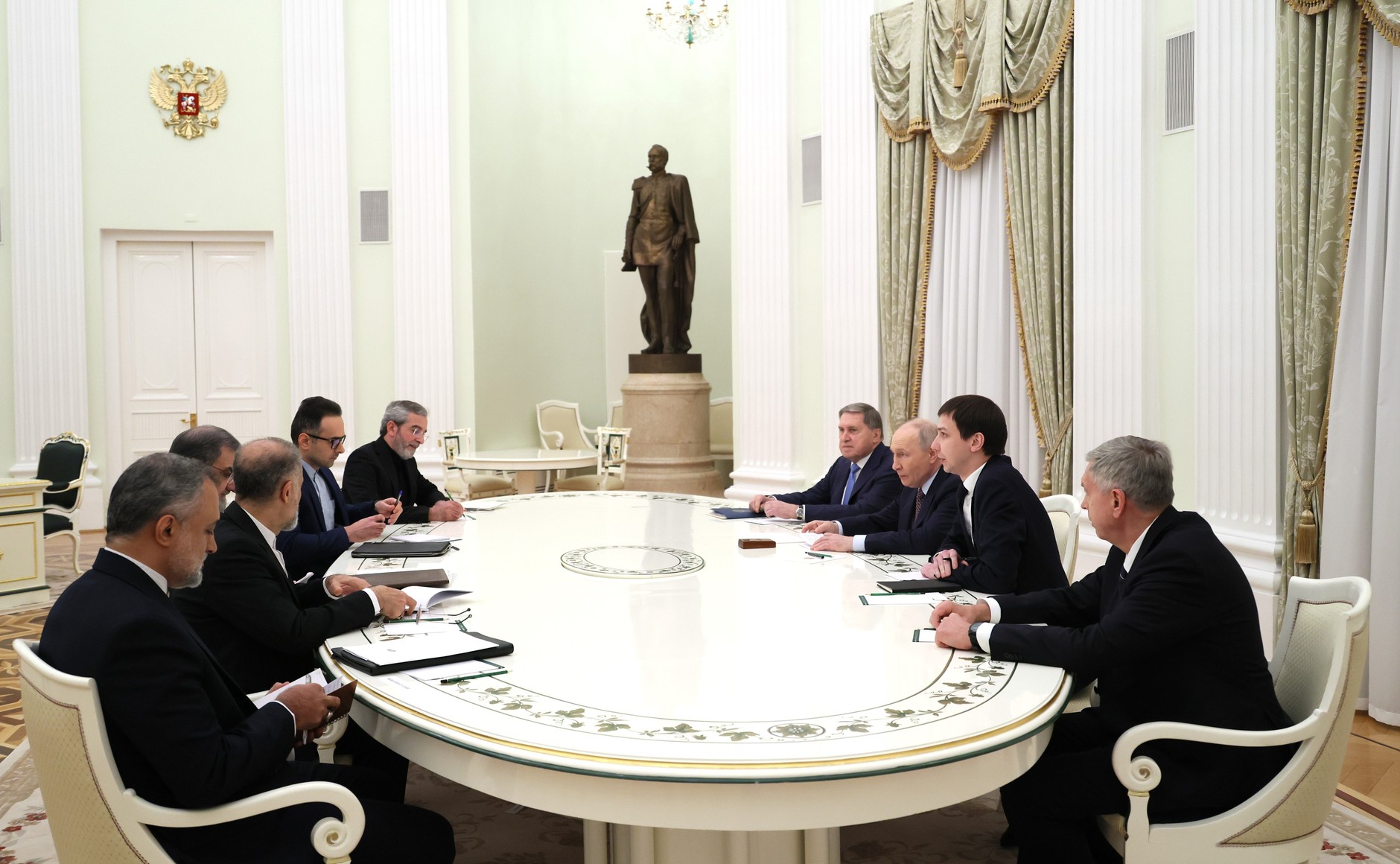
 Vladimir Putin meeting with Secretary of Supreme National Security Council of Iran Mohsen Rezaei, Kremlin, Moscow, Nov 5, 2026
The US Vice-President JD Vance’s famous statement within hours of the midterm results that “the reason we lost is the Iran war” may appear to be a calibrated distancing from President Donald Trump. Indeed, he alluded to Trump: “If you’d like to argue it [Iran war] was worth it, that losing the Senate for the next 6 years was worth it, then do so. Argue it was a worthwhile cost to pay. Agree or disagree. That’s at least honest.”
The western media was quick to interpret that Vance was speaking with an eye on the 2028 presidential election. But there is a contradiction. For, he must be a lousy politician not to know that for making a bid for the White House, he must first secure the Republican nomination, and annoying Trump wouldn’t be the smartest way to unify MAGA. The Trump brand failed to impress the voters but his hold on Republican Party is substantial.
Besides, Vance showed his statement to Trump before issuing it.
From Trump’s perspective too, there is nothing earthshakingly new in Vance’s statement. Vance is a longtime vocal critic of US foreign interventionism. The paradox is, it was one of his virtues that Trump spotted in the youthful senator from Ohio while inviting him to be his running mate in the race for the White House.
Vance was skeptical about the war against Iran and was the only figure in Trump’s circle who refused to endorse Benjamin Netanyahu’s bid for re-election as prime minister. He watched with profound disquiet the immense pressure that the Israel Lobby brought to bear on Trump to kickstart the war in February.
What happens next? There are 3 ways of looking at it. Would Trump dump Vance from his team? Would Vance recant? Would Trump be persuaded by Vance?
The answer to the first two questions is an emphatic ‘No’. The third question matters. Ideally, one would have waited for the US-Russia-China trilateral meeting due to take place only ten days from now in Shenzhen, China where Trump will dwell on his vision of a new world order.
Be that as it may, the big question is, how Trump weighs in on the Iran question. According to leaks of a testy phone conversation with Netanyahu in the weekend, Trump reiterated his preference to negotiate a deal with Iran.
Trump’s stated position, as he told the media yesterday is: “In Iran, we are there for seven months, and we control everything that we’ve wanted to control. And now we’ll make a decision: do we want to go further and just certify it. By certifying it, meaning it’ll never happen again. I think it’ll take them 25 years to rebuild the country. I would rather not destroy the rest of the country if possible, but maybe I’ll have to. You’ll know soon enough.”
The odds are, increasingly, that Trump, a quintessential realist and pragmatist, realizes Netanyahu is using him as a doormat to cling to power. But what’s there in it for Trump himself? There is no question that a war cannot help reach a settlement with Iran. On the contrary, a war will create a festering wound that could turn gangrene and might well come to define his presidency in history books – as happened to Lyndon Johnson, a truly tragic figure.
Furthermore, the new Congress dominated by the Democrats will most certainly turn into an albatross. Iran war, Democrats saw, is a vote-catcher.
On November 2, in anticipation of the temperature rising in the Persian Gulf, the Russian foreign ministry spokesperson firmly advised Washington against the war option, saying, “The tragic experience of recent months demonstrates that military adventures, sowing death and destruction in Iran, are powerless to break the will of the Iranian people to uphold the sovereignty and independence of their country. Those who today threaten new strikes would do well to reflect on this.”
Against such a backdrop, it is hugely significant that there has been no attempt whatsoever at the top levels of Iran’s leadership to resort to polemics to humiliate Trump or beat the war drum at this critical juncture. China Daily, with its antennae all out, spotted this. In a report on Thursday titled Tehran says reignited conflict would benefit no one, China Daily carefully sized up the shape of things to come: “Amid fears of fresh US strikes on Iran after the midterm elections, Tehran has warned that renewed all-out conflict would benefit no one, saying the onus is on Washington to avert such a scenario…”
Suffice it to say, today’s New York Times report arrives at the same conclusion as China Daily: “Iran is reviewing a set of proposals presented by mediators that could shape the future of its nuclear program, according to five officials briefed on the negotiations, representing a potential breakthrough in stalled diplomatic efforts to end its war with the United States.
“Iran’s willingness to re-engage in nuclear talks, after weeks of refusing to budge, suggests recent mediation efforts led by Qatar to prevent a return to full-blown war have had some success, the officials said. They described the terms being reviewed as “concrete proposals,” without elaborating.”
The bottom line: Vance is very much in the vanguard of decision-making in Trump’s inner circle. Curiously, another Times report, a week ago, underscored Vance’s crucial role in moderating the ‘mood’ in Tehran by addressing a letter to the powerful national security chief Mohsen Rezaei, the head of Iran’s Supreme National Security Council — on Trump’s instructions of course — proposing to hold direct peace talks that would also cover Iran’s nuclear program.
Rezaei, a veteran commander of the Islamic Revolutionary Guard Corps (IRGC), having served as its Commander-in-Chief for 16 years from September 1981 to September 1997, reacted subsequently that Vance’s letter had shown that the US had changed its tone toward Iran. And it set the ball rolling.
Yesterday afternoon, Rezaei arrived in Moscow on an unannounced top secret visit, and was received by Russian President Vladimir Putin at the Kremlin. The Kremlin readout gave no details.
The picture, though, showed Putin flanked by foreign policy advisor Yuri Ushakov on the right and the powerful chief of GRU, Gen. Igor Kostyukov, who is in charge of Russia’s super sensitive high tech satellite intelligence system on the left.