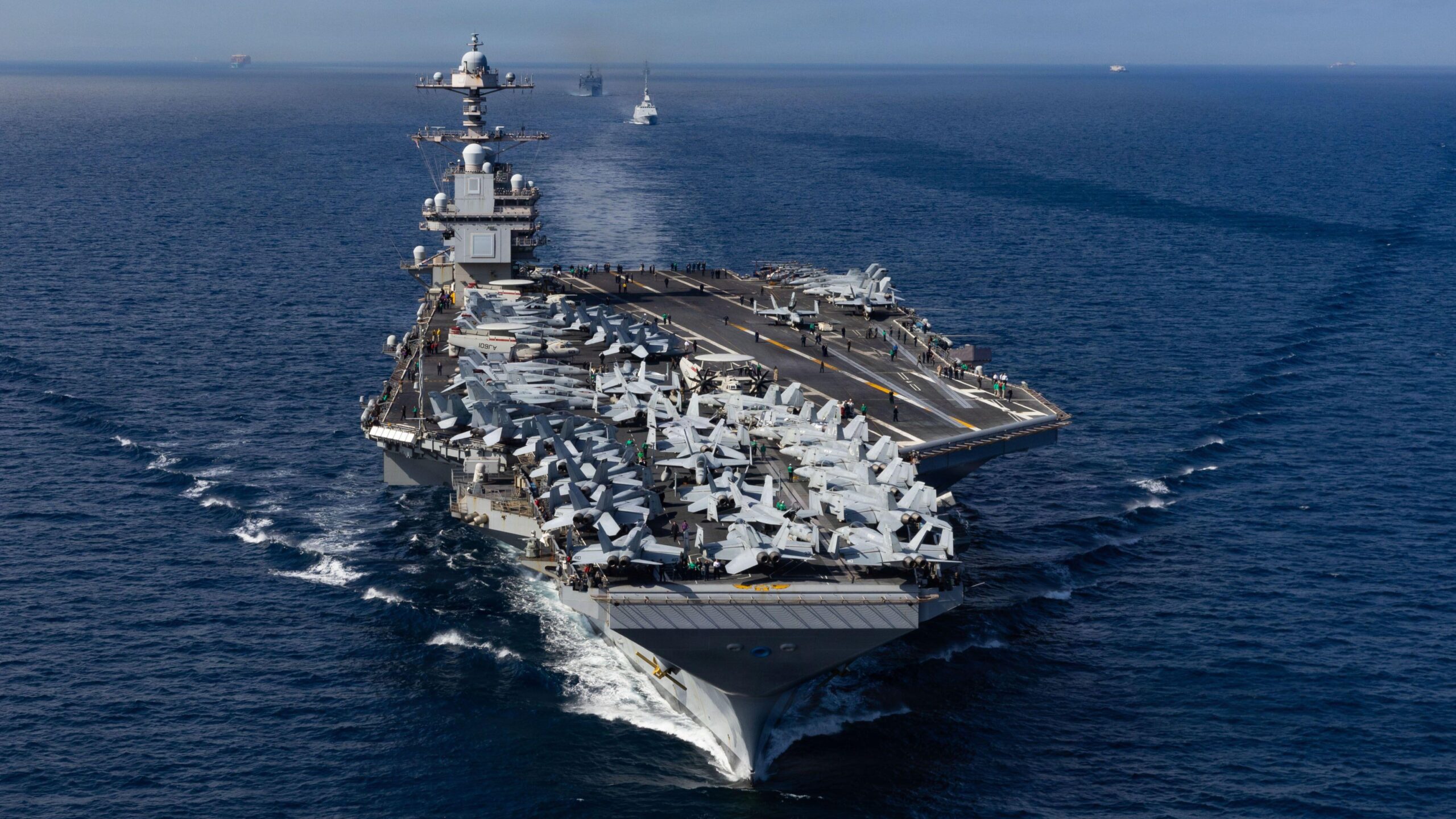
 The deployment of the USS Gerald R Ford carrier group marks a significant escalation with Venezuela (File photo)
The iconic figure in contemporary American journalism Tucker Carlson said earlier today in the famous podcast Judging Freedom hosted by Judge Andrew Napolitano that US President Donald Trump will declare war on Venezuela in a speech scheduled for tonight. Gunboat diplomacy is getting a fresh lease of life.
It signifies many things. The most obvious is that the leopard can’t change its spots. Gunboat diplomacy is a historical legacy handed down by Western powers, especially the United Kingdom, France, Germany and the United States who used their superior military capabilities, particularly their naval assets, to intimidate less powerful nations into granting concessions. China was its most tragic victim.
The UK, France and Germany are erstwhile great powers who have fallen from the pedestal of great powers during the Cold War era once the US emerged as the leader of the western world. The Suez Crisis of 1956 precipitated by the UK, France and Israel in reaction to the nationalisation of the Suez Canal by Egypt was a turning point when it ran into opposition from US-sponsored resolutions in the United Nations (made in part to counter Soviet threats of intervention), which quickly put a stop to the Anglo-French aggression. France continued to practice gun boat diplomacy up until the overthrow of and gruesome murder of Muammar Gaddafi, but then, that came to an ignominious end in the Sahel following Russia’s arrival in the region as a rival power.
Gunboat diplomacy in Trump’s toolbox acquired new features due to an awareness that America is a diminished power today and it lacks the capability to impose its will on other countries. Outright aggression against sovereign states has become a perilous option, as the defeat in Iraq and Afghanistan showed. Trump is also wary of leading the US into anymore ‘forever wars’ as that would be a drain on the American economy. Besides, Axios wrote recently that Trump is “is flirting with one of the most toxic ideas in American politics — a new foreign military intervention — at one of the most precarious moments of his second term… Trump’s push toward regime change in Venezuela threatens to deepen a MAGA rift.”
Nonetheless, Venezuela is set to become the testing ground for Trump administration’s gunboat diplomacy. There is likelihood of Trump ordering an invasion but then, one can never be sure of his disposition. Even Tucker Carlson admitted so. Trump’s press secretary has not ruled out the possibility of US troops being deployed on the ground in Venezuela, telling reporters that “there’s options at the president’s disposal that are on the table”. Military analysts have noted that the US deployment in the Caribbean is on a much larger scale than needed for a counternarcotics operation, which has been his alibi. Trump has ordered “total and complete blockade of all sanctioned oil tankers going into and out of Venezuela”
Last month, the Senate narrowly voted down a War Powers Resolution that would have blocked the US from attacking Venezuela without congressional approval. Yesterday, the House of Representatives followed suit narrowly voting to reject a resolution to prevent the use of unauthorised military force against Venezuela, amid escalating hostilities. In legal terms, a blockade is an act of war. Trump himself would only say that President Nicolás Maduro’s “days are numbered.”
Meanwhile, Trump has come clean, for the first time, with another national security priority, the US’ interest in Venezuelan oil and gas. Venezuela has the world’s largest oil reserves, which the American oil companies had helped develop exactly one century ago. In Trump’s words, “You remember, they took all of our energy rights, they took all of our oil from not that long ago, and we want it back, but they took it. They illegally took it.” He was referring to the nationalisation of the foreign oil companies in 2013 by late Hugo Chavez. The cat is out of the bag, finally. Maduro hit back calling it “resource colonialism.”
Trump’s alibi of Venezuela indulging in drug trafficking all along lacked credibility. The country is only a transit corridor and the main producer of fentanyl in Latin America is actually Mexico.
At any rate, Trump’s move to block Venezuelan oil exports is misguided, at best — unlikely to lead to political change in Caracas while it may cause economic pain and will even be counterproductive, increasing Maduro’s ratio of power over the population.
That brings in a tantalising train of thought: Trump has no doubt put on real pressure on Maduro and the country, and it could be used to try and negotiate. Simply negotiating Maduro’s exit is probably not going to work, as people tend to see all this as an anti-imperialist revolution and a big slice of the country’s population may want to see the government as well as Chavismo (left-wing populist political ideology) to continue.
On the other hand, any real outcome of the sort Trump expects may not happen even with some sort of a military strike (which is being discussed in some quarters) that may ultimately only create chaotic conditions in America’s backyard, like in Haiti next-door, in which the US expeditionary force may get bogged down. Venezuela is a large country, 1.5 times the size of Texas and comparable to Pakistan or Nigeria, and with a highly diverse and often difficult terrain that includes towering mountains, dense tropical jungles, broad river plains, and swampy deltas.
Overall, therefore, as David Smilde, professor at Tulane University who has written extensively about Venezuela for over three decades puts it, “The one possibility is if President Trump could use all this pressure to try to negotiate some sort of reasonable transition that would have to include Chavismo in some way.”
But that becomes a revolutionary idea in itself — gunboat diplomacy triggering non-violent regime change allowing co-habitation with a leftist populist ideology blending Bolivarianism, socialism and socialist patriotism and characterised by strident anti-imperialism. But then, arguably, Trump has amiably accommodated New York Mayor Zohran Mamdani, whom he once called a “communist”.
Beneath the rhetoric, probably, Trump still favours a negotiated exit for Maduro even while ordering CIA covert operations inside Venezuela and reserving the option to order land strikes at any time. By the crack of dawn tomorrow, we will know which way Trump’s mind is working.