
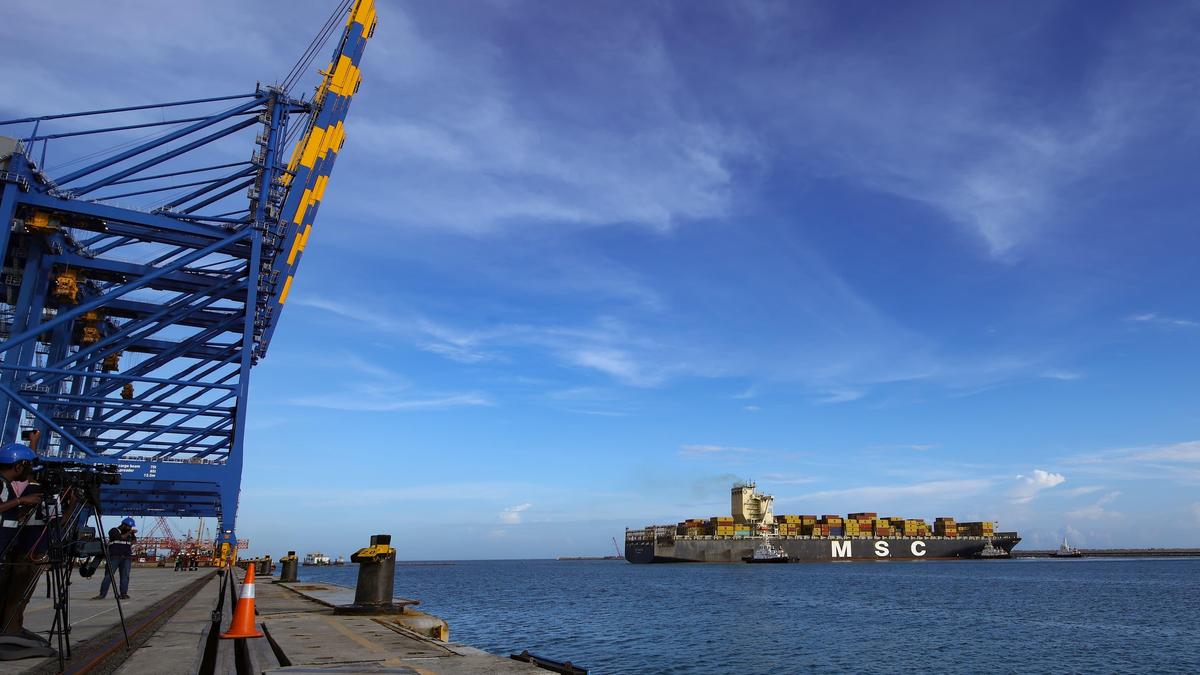
 An MSC vessel at the Vizhinjam International Seaport, Thiruvananthapuram, Kerala
The transformative phase of politics in Kerala shifting away from ideological paradigms surged with the announcement by the state BJP President Rajeev Chandrasekhar on Sunday that Thiruvananthapuram would be home to one of India’s first university townships.
The BJP has literally co-opted a flagship of the previous Left Democratic Front government led by Chief Minister Pinarayi Vijayan whose crowning glory just before meeting the train crash in the last state election in May and abdicating power was the policy decision to fast-track Vizhinjam port-led industrialisation anchored on the development of a 62-kilometre corridor from Vizhinjam to Navaikulam linked to the deep-sea port as industrial, commercial and service-related sectors, including an IT integrated hub called Neopolis.
The hankering for good education as the key to a better life for children is no more a middle class (‘bourgeois’) phenomenon in Kerala. While the middle class parent has an option to muster the financial resources to send children to other states or abroad, given the deplorable state of affairs in higher education in the state where ‘politicisation’ has created havoc, the lower classes do not have that luxury. And there is growing frustration on that score.
At a recent colloquium in Kottayam with post-graduate students preparing for the civil service examination, almost entirely drawn from poor families in rural areas, whose only assets are their bright minds and aspirations for a better life, they poured out their sorrows that the ‘coaching classes’ for training candidates for the civil services examination are unaffordable due to high tuition fees and other overheads. Successive state governments ignored their plight.
Suffice it to say, the BJP has done a smart thing by zeroing in on the education sector as a visible template of its political platform in Kerala. Rajeev Chandrasekhar’s announcement will go a long way to moderate the perception of its religion-based politics, which is struggling to find acceptability in the state. No doubt, it will attract the attention of the youth and the middle class parents that unlike the entrenched political formations, the BJP is seriously applying itself to salvage Kerala’s education sector from the predatorial clutches of the two rival united fronts, especially the Left front.
Fundamentally, this is progressive politics. It has come as a pleasant surprise that Finance Minister Finance Minister Nirmala Sitharaman’s announcement while presenting the Union Budget 2026 in February on the establishment of five university townships near major industrial and logistics corridors is bearing fruition without much time lag, announcing Kerala as one of the five states in the country. It stands to reason that the Chief Minister VD Satheesan conveyed to Prime Minister Narendra Modi and Sitharaman the state government’s full support for this decision when he prioritised a call on them soon after the state election to discuss the state’s urgent requirements.
Sitharaman proposed that the university townships will function as integrated academic hubs, featuring multiple universities, colleges, research institutions, skill centres, and residential complexes. She also announced that one girls’ hostel will be set up in every district to support female students facing education and work-related challenges.
Hopefully, the central government’s decision to give pride of place to Kerala will get the all-out support of the Congress-led state government and the opposition parties. Education should not be an arena of competitive electoral politics. The political parties that have attempted and got away with such shenanigans should be exposed as predators.
The future of Thiruvananthapuram is going to be inextricably linked to the BJP’s decision to make the district one of India’s first five ‘university townships’. The BJP would have a special interest insofar as Thiruvananthapuram is fast becoming the party’s citadel which elected two assembly members in the May election, plus the fact that they are two stalwarts of the party with a national profile — Chandrasekhar himself and ex-MOS V. Muraleedharan — will help matters to accelerate the project going forward.
Interestingly, Kerala has elected to power a strong Congress-led government with a massive majority but that has not deterred the central government from taking this crucial decision to transform the state as an education hub.
From such a point of view, a positive beginning has commenced in the centre-state relations in the sensitive education sector in Kerala. The point is, generous central assistance is a crucial prerequisite for the successful implementation of such capital-intensive projects.
Are we on the threshold of a new paradigm in state politics? The BJP will have a pivotal role to play in a transition of the highly competitive electoral politics in the state from mud-slinging against each other by political parties in power to development-related issues on which the state’s future hangs in balance. The so-called Kerala model of development needs to evolve quickly in real time to cope with the massive economic and social transformation that the country is witnessing. No state in the country, howsoever strong the government in power is, can pretend to be an island.
To my mind, the Kerala model of development whereby the government distributes its income almost entirely as salaries and pensions for government employees and subsidising what passes for ‘welfare schemes’ has reached a plateau that is unsustainable.
Regression, as evident already in the education sector, is avoidable if only the political parties in the state do creative thinking on the leitmotif of politics. Or else, both the political formations — the Congress-led UDF and the CPM-led LDF — will have to surrender space to the BJP as the catalyst of change and progressive thinking.
This is more of an existential threat for the communist parties unless they are willing to adapt to the transformative climate in the country, especially if the BJP succeeds in advancing the One Nation, One Election plank aligning the election cycles of the Lok Sabha and State Assemblies by the time of the next general elections due in 2029, which is becoming a palpable reality that the nation will come to accept, given the confusion and hopeless disarray visible within the INDIA Front already with the Neanderthal men leading the miniscule, fragmented constituent parties at a loss even to make up their mind who is their real adversary — Congress or the BJP.
Things are moving so fast that Vizhinjam, an ancient sleeping village in the suburbs of Thiruvananthapuram, is poised to be the locomotive of change in the state. According to a report in the Hindu, the world’s largest container shipping company in the domestic port infrastructure in India, the Switzerland-based Mediterranean Shipping Company (MSC) Group, is acquiring a 49% stake in the Vizhinjam International Seaport in Kerala for $1.397 billion (around ₹13,220 crore).
MSC is the world’s largest privately-owned container shipping line controlling over 21% of global container capacity (surpassing Maersk in terms of TEU capacity), which is seized of the strategic location of Vizhinjam Port overlooking the sea lanes of Asia. Founded in 1970 by an Italian seafaring captain-cum-entrepreneur Gianluigi Aponte, a secretive Italian billionaire whose net worth is estimated to be of $25.6 billion, according to the Bloomberg Billionaires Index, the MSC is headquartered in Geneva.
How much has Kerala politics changed already in the recent decade under CPM rule! In my student days, red flags would have appeared by now all over Thiruvananthapuram that a multi-national is spreading tentacles in the ‘red rain land’.